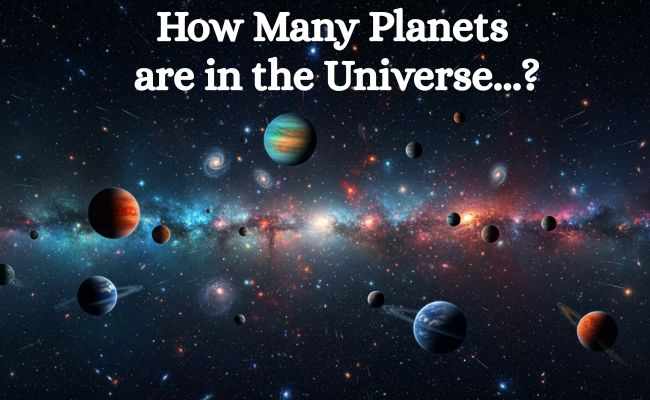
Have you ever looked up at the night sky and wondered, “Just how many planets are out there?” It’s a question that captures the imagination—planets beyond our own, orbiting distant stars, hidden in galaxies far away.
In this article, we’ll explore what astronomers currently know about “how many planets are there”, how they make estimates, and why the answer is so mind-bogglingly vast.
Known Exoplanets
-
As of now, astronomers have discovered more than 5,800 planets beyond our solar system—these are known as exoplanets.
-
When you include the 8 planets in our own solar system, the total known count reaches about 5,893.
-
But that number is just the tip of the iceberg. All of these known planets lie within our Milky Way galaxy. We haven’t routinely confirmed planets in other galaxies.
Why so few discovered so far?
Finding planets across cosmic distances is very challenging. Planets are small, faint, and lost in the glare of their parent stars. The techniques we use—such as the transit method (watching for dips in starlight when a planet crosses in front) or the radial velocity method (measuring a star’s “wobble” due to the gravitational pull of orbiting planets)—are powerful, but limited by distance, sensitivity, and observational constraints.
These methods are mostly effective within our galaxy, and only for certain types of planets (e.g. those that transit edge-on or produce measurable gravitational effects). Many planets are missed: small ones, those that don’t align with our view, or those in systems too far or faint for our instruments.
One-Planet-Per-Star Rule
Astronomers often use a rough but useful heuristic: one planet per star, on average. This is based on observations of exoplanet systems and statistical modeling.
-
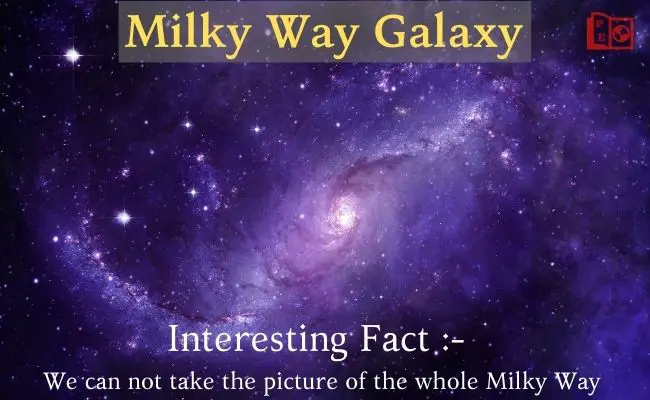
Our galaxy, the Milky Way, is thought to contain around 100 billion stars (or more).
-
If each star hosts, on average, at least one planet, then the Milky Way might harbor on the order of 100 billion planets.
-
But then, how many galaxies are there? The observable universe may contain at least one trillion galaxies (and possibly many more, depending on what lies beyond the observable limit).
-
So, by multiplying 100 billion planets × 1 trillion galaxies, astronomers arrive at an estimate of roughly 100 sextillion planets (that’s 10²³ planets).
Thus, while we’ve only detected a few thousand so far, the universe may contain an astronomically larger number of planets—perhaps 10²³ or more.
Caveats & Challenges in Estimation
While the “one planet per star” rule is appealingly simple, there are a few important caveats and uncertainties:
-
Planetary systems are diverse: Some stars host many planets (like our Sun), others may have none, and some may have planets that are hard to detect (very small, or in wide orbits).
-
Bias in detection: Our detection methods favor large planets or those in short orbits. Many smaller, more distant planets may exist but remain invisible with current technology.
-
Uncertainty in galaxy count: The estimate of “one trillion galaxies” is itself uncertain; deeper observations and future telescopes may revise that number.
-
Non-observable regions: The “observable universe” is limited by the speed of light and the age of the universe. There may be many more galaxies (and hence planets) beyond what we can currently detect.
-
Habitability vs existence: Even if there are 10²³ planets, it doesn’t mean all are Earth-like or habitable. The conditions for life depend on many factors (atmosphere, temperature, liquid water, etc.).
So though the estimate is enormous, it is still just a model-based projection, not a definitive count.
Techniques for Detecting Planets
Here are key methods astronomers use to discover exoplanets:
-
Transit Method: When a planet passes in front of its host star (as seen from Earth), it causes a tiny dip in the star’s brightness. By measuring these dips repeatedly, we can infer the planet’s presence, size, and orbital period.
-
Radial Velocity (Doppler) Method: A planet exerts a gravitational tug on its star, causing the star to wobble slightly. That wobble shifts the star’s light spectrum (via the Doppler effect). This method helps estimate the planet’s mass and orbit.
-
Microlensing: When a foreground star (with its planets) passes in front of a background star, its gravity can act as a lens, magnifying the background star’s light. The presence of planets can create additional subtle blips in the lensing pattern. This method is promising for detecting planets farther out or even in other galaxies.
-
Direct Imaging & Other Methods: In rare cases, telescopes can directly image large exoplanets (especially young, hot ones far from their star). Other emerging techniques, like astrometry (measuring precise star movements), may become more powerful with future telescopes.
Each method has strengths, limitations, and biases (e.g. favoring large or close-in planets). The more methods we combine, the better our planet census becomes.
What This Means for Life & Future Discoveries
With such enormous numbers of planets, many people naturally ask: Is there life out there? While we don’t have an answer yet, the sheer scale suggests that conditions suitable for life might occur somewhere. Yet the rarity of life (and Earth-like environments) remains unknown.
Looking ahead:
-
Next-generation telescopes—both ground-based and space telescopes—are being designed to detect smaller, Earth-sized exoplanets and even search for biosignatures (signs of life).
-
Missions like the Habitable Worlds Observatory (planned by NASA) could revolutionize our ability to detect atmospheres, chemical signatures, and even traces of life on distant planets.
-
As detection capabilities improve, our models and estimates for the total number of planets will become sharper. We may even detect planets in other galaxies more reliably in the future.
So, how many planets are in the universe? The answer is: far more than we’ve yet discovered. While we currently know of about 5,800 exoplanets within our own galaxy, statistical estimates suggest there could be on the order of 10²³ planets (or more) when we consider all galaxies in the observable universe.
The journey of discovery has just begun. Each new planet we detect, each refined estimate we make, brings us closer to understanding our place in the cosmos: Are we alone? Or just one among countless worlds?